
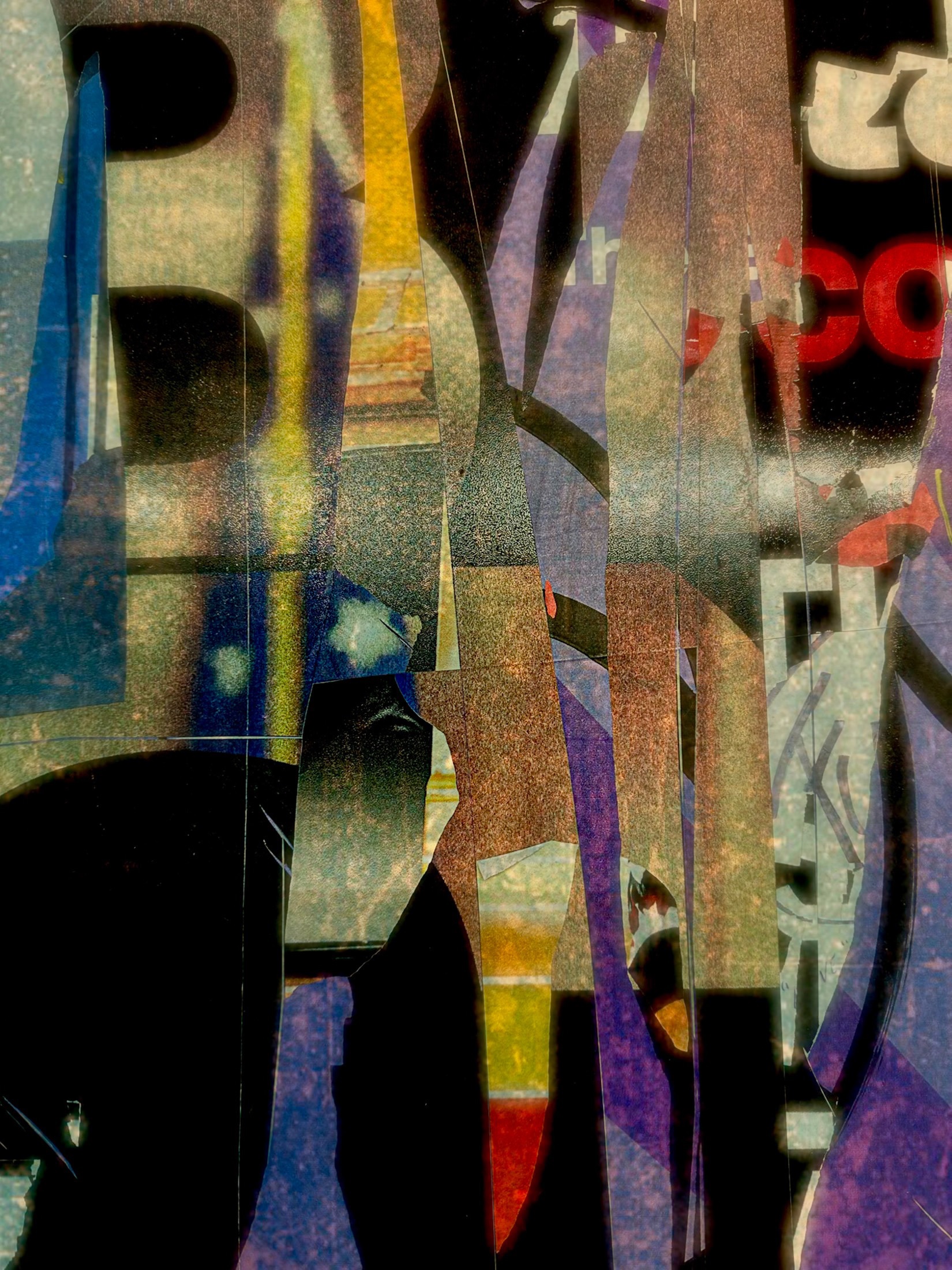
Untitled by Lilyan Aloma
In A Family Way
My granddaughter Isla tried to say Grandma
when she was a child, a word that emerged as Bambi:
I wonder what names her child will later bestow
on my daughter and me. In Canada, six generations
in an unbroken line of women took monikers different
enough that the kids could distinguish each grandma
from all the others. In some whale species, the females
cease in midlife to bear offspring but, like humans,
live decades longer to share in the nurture of their line
of descendants. Having achieved great-grandmother
status myself, I’m now privileged to witness one more
genetic edition of Me—a reflection, perhaps, of the truth
that what’s separate from us is also of us. Whale
young develop signature whistles that set them apart,
the way my grandniece’s voice could reach air-horn levels,
or Fanny Brice garnered “Baby Snooks” radio fame
with her little-girl pitch. Humpbacks “converse”
in units of sound—whups, barks, and growls—combined
into phrases with a reliable syntax; sperm whale clans
create codas of clicks that identify each by the dialect
of its ocean locale. Sameness in difference. A vernacular
as distinct as my own family argot: phrases borrowed
from Shakespeare and Monty Python.
Dancing with Glass
The Shadow Knows
“Hi” was the only word I could muster
when, lying in bed, I opened my eyes
and saw a shadowy figure, darker than night,
where the streetlight shone in.
Featureless. Motionless. Male. Not my father.
Nor the shadow that flickers in the peripheral vision,
gone when you turn to look. Much too dense
for the thin silhouette of a spirit escaped from the tomb.
Once, walking home after dark as a child,
I watched my shadow swell from a gnome
to a skeletal beanstalk, then flit suddenly back
to stalk me again like a ghost of itself:
a shock when a trusted companion
not only fails to behave in the usual way
but menaces you as a shape-shifting ghoul
with a power and will of its own.
Shadows dwell in the liminal space
between evil and good—
although they are neither themselves—
that the Grim Reaper requires their consent
before claiming a soul, and that even Hades steps back
for the shadows that come every spring
to bring Persephone back to her mother.
So why did the shadow that loomed in my doorway
provoke such a curious absence where terror belonged?
I simply stared at its darkness with wide-awake eyes—
though I opened them wider
when
“Hi,” it said back. And morphed
into my boyfriend, home on leave
and foolishly daring my father’s wrath
by sneaking up to my room
to surprise me at midnight.
About the author:
Sharon Whitehill. I’m a retired English professor from West Michigan now living in Port Charlotte, Florida. In addition to poems in various literary magazines, my publications include two academic biographies, two memoirs, a full collection of poems, and three poetry chapbooks. My latest, THIS SAD AND TENDER TIME appeared (Kelsay Books) in December 2023.
In the artist’s words:
Lilyan Aloma. The images in this body of work reflect my ongoing fascination with billboards and their visual influence on the urban landscape. As construction sites continue to surge, and the visual horizon swells with new building, posting bills finds fertile ground for sending us their messages of what we should buy, participate in, or think. Each construction site, laden with multiple layers of ads, reveals a peeling away, an erosion. I have coined them “deconstructions,” which aside from the physical evidence of erosion, reflect a sociological reality, as the invasion of commerce manipulates us, deconstructing our reality, as well. Between the layers of aging advertisements emerged impressions, a fresh canvas for me to create and have fun with. It is my attempt to resolve the visual tension created by the over-development of the city that I have lived in and loved most of my life. At the heart of my photographic work over the past fifteen years has been my fascination with Manhattan’s cityscape, and its constant evolution.
Between 2003 and 2009 I had 3 solo exhibitions at OK Harris Works of Art, entitled, Mecca or Madness, Billscapes, and Deconstruction. My cityscapes have received recognition through national and international juried competition, which include: Tokyo International Foto Award, Moscow Foto Award, Paris Photo (PX3), American Photography, Julia Margaret Cameron Award, International Photographers of America, and others. In 2010, I won an IPF fellowship from the Aaron Siskind Foundation for my work entitled, “Billscape.”
Articles about my work have been published in Black & White Magazine, Art Dealer Street, Dodho Magazine, Photography Annual 2020, and Silvershotz Magazine. My earlier analog work can be found in the collections of Beinecke Library at Yale University, The Brooklyn Museum, Stein Rogan Advertising, The Museum of the City of New York and The New York Historical Society. “
Specific to my development as a visual artist, my work derives inspiration from the surrealism of Jerry Uelsmann, the abstractionism of Aaron Siskind and the graphic awareness of M.C. Escher. Of additional significance is the work of the early street photographers, Henri Cartier-Bresson and Brassai¨and their focus on urban life and the physical form of the cityscape. Lastly, the optical infatuation of Abelardo Morell has enriched my visual point of view greatly.”