
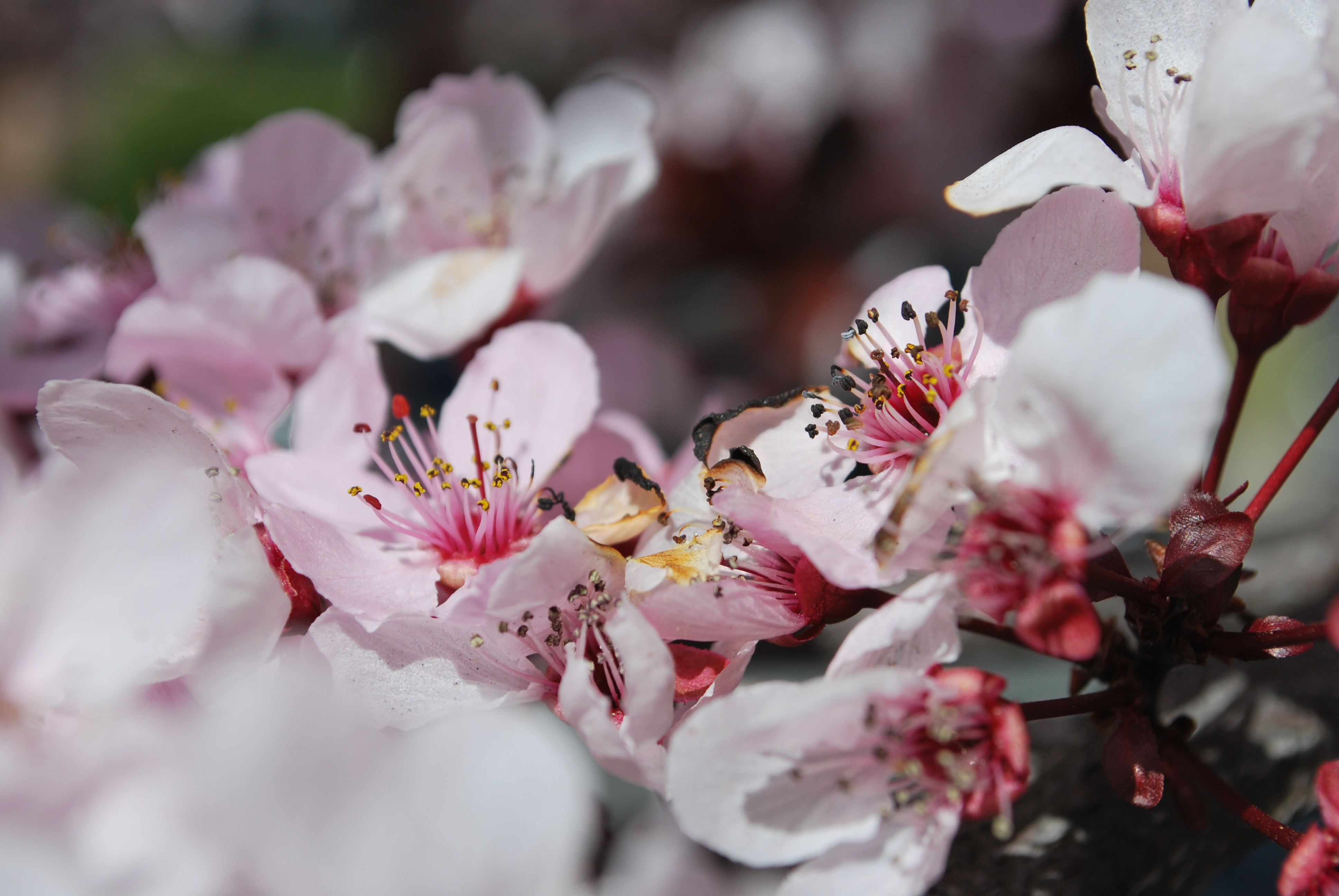
Stockton Spring by Cela Xiè
The Lost Wings
Many years ago, in the fairy kingdom of Alatorna a sudden blight appeared, and no one
knew why. In the winter cold, fairy leaders speculated that some microbe had overwhelmed
their people. Or maybe an invisible Demon had come—why?—to cause unhappiness. He
made their wings drop off, leaving everyone mutilated and bound to the earth.
Celiana had feared it, and then it happened. First the right, then the left wing pulled
loose and dropped off. She wasn’t surprised or shocked, just saddened. She sat by a slow-
moving brook and absentmindedly tugged at her reddish-blond hair. The wings lay in her
lap. She stroked them, noticing how their translucent panels were held together by dark
veins that resembled the leading in stained-glass windows. What to do with them? She could
store them in a chest at home, a little birdhouse perched in the branches of a huge old oak.
But, no longer able to fly, how could she transport them there? She must be brave, must let
them go. She stood and slid the wings into the water of the stream. They floated away,
trembling and shining on the surface of the water, smaller and smaller. Gone. Celiana’s eyes
filled with tears. She turned away and began walking home.
On her way she met her friend Fantasiana, who had lost her wings a few days before.
The two embraced and cried silently, then stood back from each other. “Fantasiana, you
don’t look like yourself without your wings.”
“I know. And it’s worse than that. I no longer know who I am. To qualify as a fairy,
you must be small, you must be beautiful, and you must have wings. So what am I now?”
“You are my friend,” Celiana said. “Let’s begin with that.” The two walked for a
while, shivering at cold gusts of wind. Celiana slipped her hand along her friend’s back until
she felt the rough place where a wing had been. She didn’t yet have the courage to explore
her own shoulders.
Fantasiana said, “It’s a little sore where they were. I will never let anyone see the
scars. They are too ugly. We are supposed to be beautiful.”
Celiana paused. “But maybe it is enough to have a beautiful mind or soul, even if
your body is scarred.”
“Maybe. I don’t know. And I don’t know if I have a beautiful mind or soul anyway.
I’m so sad since it happened.”
“Beauty and sadness could co-exist in the same mind, I think.” Celiana wasn’t sure
about this, but she liked how it sounded, and Fantasiana didn’t contradict her. Anyway, they
had now reached her home tree, and she was going to have to climb it. Which turned out
not to be very hard because she managed to find footholds in the bark. Once at her door,
she looked down at her friend, who waved before continuing on.
Besides climbing trees, another new activity Celiana took up was swimming, as soon
as the days were warmer. One day she saw a boy fairy rowing a little shallop through the
water. He would dip his oars in the stream and propel the boat forward. Though Celiana
didn’t have a boat, she knew a body could move itself through water. She began going to the
brook every day and gradually learned how to manage this without drowning. Sometimes
Fantasiana came along to encourage her but never tried it herself. Soon Celiana became a
skillful swimmer. This smooth gliding through water was the next best thing to flying. She
had taken a couple of fish bladders, inflated them, and tied them on her shoulders, calling
them her “water wings,” and, yes, they buoyed her up, just as her real wings had lifted her
into the air. It was fun to make graceful strokes, feeling the cool wavelets slide along your
back and legs.
During one of her swims, she saw the boy rowing towards her. He seemed surprised.
They both stopped moving and floated quietly until he said, “My name is Bonavitor. I never
knew a fairy who could swim.”
“I learned how after I lost my wings.” And then, “My name is Celiana.”
“I’m sorry. About the wings, I mean. But I’m glad you learned to swim. When I lost
mine, I began rowing, and I like it just as much as flying.”
She wasn’t sure she believed him, but she nodded. “Well, enjoy your rowing,” she
said and began swimming away. Then she looked back and saw that he was watching her.
A few days later the Angel arrived. The Angel still had its wings and these were
covered with feathers. Both the feathers and the Angel’s robe glowed strangely, as though
moonlight could be seen in daylight. Seeing them gave Celiana a pang. Not what she was
used to, but it seemed wings could be made of other materials. If they allowed you to fly,
what did it matter?
With a loud voice the Angel summoned everyone into the main square. Alatorna’s
grieving inhabitants wondered why. They waited until everyone arrived, faces familiar to
Celiana since childhood, though touched now with sadness.
Then the Angel spoke: “Citizens of Alatorna, I thank you for your kind attention.
Word of your distress reached the courts of Heaven and it is now known The Demon did
an evil thing. But you may rejoice and be glad because reparation is coming.”
A chorus of voices rose. “Are you going to make our wings grow back? Will we fly
again?”
The Angel’s voice was serious. “Once wings are gone, they do not grow back. But
there is a solution. See the grove of cherry trees on the hill over there?” Everyone turned,
and in fact an entire hillside was covered with blossoming cherries, pink and white. “All
women fairies, young and old, must go and stand under the flowering cherries.” Then he
pointed to a long line of poplar trees. “All the men and boys must go and stand underneath
the poplars.”
Not knowing why, the fairies of Alatorna did as they were told. Celiana walked with
Fantasiana and asked, “Do you think this will turn out well?”
Fantasiana gave her head a little shake and said, “I don’t know. I’m not going to
allow myself to hope, not yet.”
Soon they were underneath the cherries and gazed up through pink and white
blossoms. A sky of perfect blue showed through, and the air was scented. A loud beating of
wings. The Angel flew overhead, and strong winds rose. Then the cherry blossoms began to
fall. They dropped in bushels, thick, fragrant, falling onto upturned faces and arms held out.
They gathered and united into wing-shaped forms, lovely to behold. Symmetrically paired
wings. Then—amazing!—each pair attached itself to a person. Soon every individual of the
crowd standing under the trees had been provided for. They touched each other, and felt
the tightly packed blossoms. Their wings began to stir. One by one, the crowd rose in the
air, tentatively, then more confidently. Every newly repaired person was flying, flying,
laughing, soaring. But the Angel was gone, never so much as saying goodbye.
When the women began to get their bearings, they saw something just as strange.
Flying toward them were the men, who had all been equipped with green wings—made of,
yes, poplar leaves! These made a lovely rustle in the air. Celiana looked and soon found
Bonavitor. They flew towards each other, hovering, and joined hands, before flying off,
away from the crowd.
A few months later they were married, the ceremony traditional in every way except
for the wings of the newlyweds, green and pink, the same as everyone who attended.
Fantasiana was the maid of honor and it was she who caught the bouquet of lilies and baby’s
breath that Celiana threw at the ceremony’s end.
The bride and groom lived and thrived. Even though they could now fly again, they
decided not to give up rowing and swimming. Celiana found that flower wings floated just as
well as the fish bladders she had used before. Bonavitor could easily row his boat if he
folded his poplar wings behind him. He taught Celiana how to row, and she taught him how
to swim. They made a perfect pair, almost as though two people joined together were
themselves a set of wings, wings of the mind and soul.
That is why the fairies of Alatorna have wings composed of leaves and flowers. They
are wiser than those who never suffered losses. Looking at them, you see an unusual depth
in their gaze. You could call it a quality of mind. Or, if you like the word, soul.
About the author:
Alfred Corn has published eleven books of poems, two novels, and three volumes of critical essays. He has received the Guggenheim, the NEA, an Award in Literature from the Academy of Arts and Letters, and one from the Academy of American Poets. In 2022, poems from several volumes were collected under the title The Returns. In 2024, a selection of Corn’s poetry, translated into Italian, appeared with I Quaderni del Bardo under the title Tutto ciò che è. In February of this year, Hosts, a collection of short stories, was published by MadHat Press. In the international category, the story “The Lost Wings” was awarded the Hans Christian Andersen Prize (for a wonder tale) under the sponsorship of the Comune di Sestri Levante in Italy.
In the artist’s words:
Cela Xiè is a nonbinary Chinese-American disabled person of twenty-five years who has accomplished nothing in particular, except for writing for almost two decades. In that time, he has written one thousand, six hundred and three poems, forty-three short stories, one draft of a memoir and sixteen thousand passable photographs. He is currently an MFA candidate at North Carolina State University. His poem “莫生 Only Absence, No Time” won the AWP Intro Journals Prize and is forthcoming from Mid-American Review. His poetry has been published by Sine Theta Magazine, Tab Journal and VOLT Magazine. He has a receipt book of poems, Before I Spoke to Myself, published by betweenthehighway press.