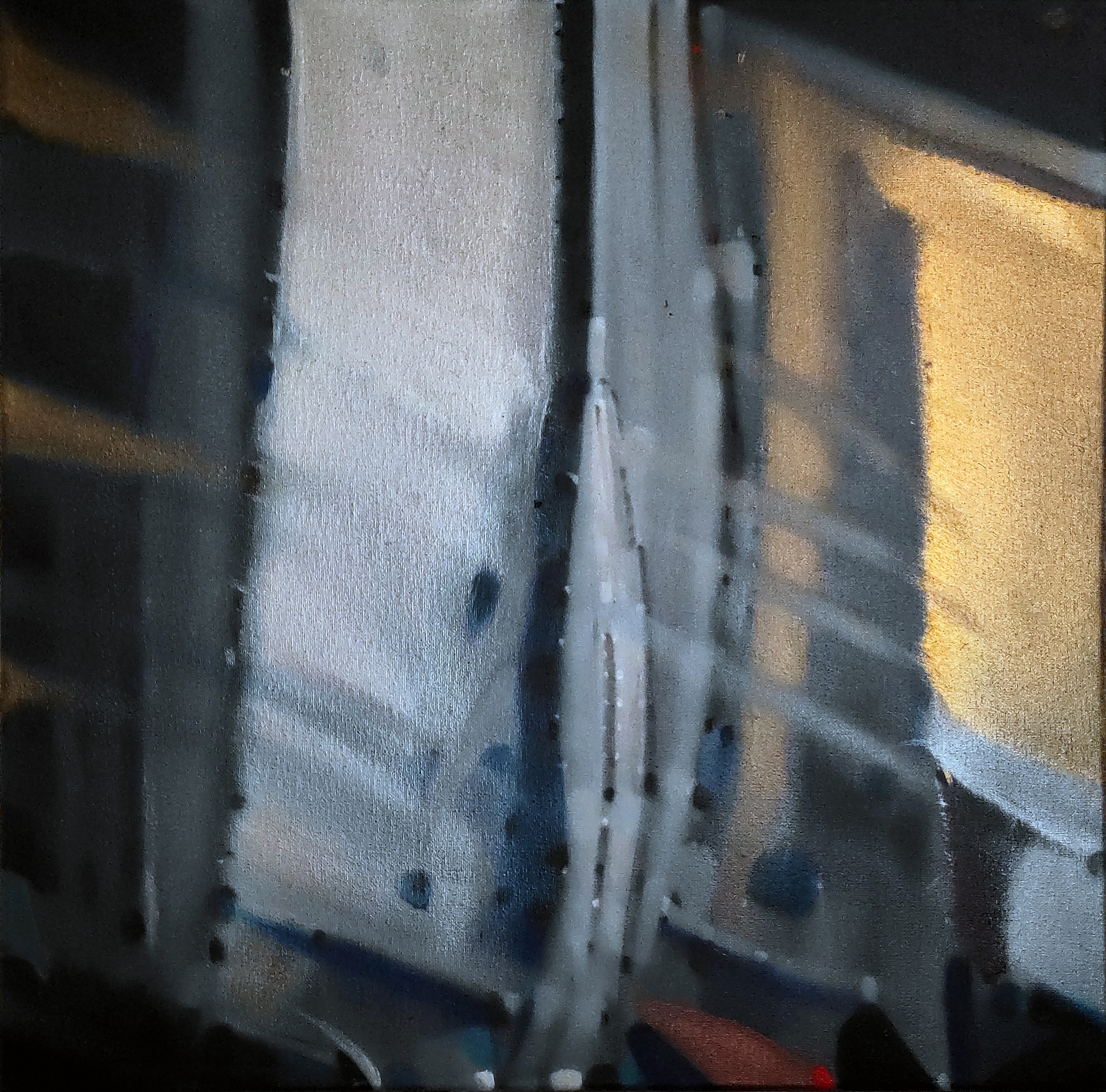
Plots into Light by Tiziana Rasile
All That Meat
One of my students told me that her pancreas
is damaged because she’s had diabetes since childhood
and her beloved father died when she was only seven years old
and I felt what I must call woe for her
because she did not deserve a damaged pancreas, no more than the other
student deserved a sudden infection of her salivary glands, or the other
an emergency appendectomy
. . . well, I asked Mary, that’s her name,
if she felt the universe was just, and she looked at me for a while,
smiled, and said “yes,” and my heart raced, how can it be?
The vicissitudes, the inequities . . . but ok, God’s ways mysterious
and all that, and it turns out in this poetry class that most
of the students are scientifically bent and study anatomy
and physiology and chemistry and find poetry superfluous
though some of them write superb poems (the ironies!)
and I begin to ramble about the schism, that old C.P. Snow deal,
and wind up marveling over how the slimy, wet chunks
of meat that constitute us all could possibly function as they do
and in particular how mind can emerge from this butcher shop stock . . .
and I must concede that miracles occur each day, we’re all miracles,
for how can abstract thought, how can a Bach or Milton
transcend the lowly organs to produce such music and poetry,
I, who make every effort to keep God out of the equations
where, apparently from what I’ve learned, God does not show up
in those runes of quantum physics (nor does time,
which is reversible therein), not because I don’t believe
but because we must make every effort to steer clear of God
when engaged in intellectual discourse, though it occurs to me
mid-sentence that in so doing we relinquish the great gift
and eradicate that which IS the just universe,
for surely God occupies every niche, however trivial,
and what else could God be but everything?
And at this moment in the spiel I stop, gaze at my students
gazing at me, and something almost holy happens . . .
I see before me a tableau, them staring forever,
me staring forever, and I think of their molecules, and mine,
of our atomic structures, and going deeper their electrons
and neurons and protons, and every sub-atomic particle
in the universe is identical, electrons, all the same everywhere,
and thus we are all the same too, we’re each other,
and the atom is mostly empty space, and it becomes an atom
when Heisenberg looks at it
and we’re looking at each other, and the electron is either
a particle or a wave, if Schrodinger is right, and thus
both potential and actual at once, depending
upon who gazes, and we’re gazing at one another,
creating each other, why not? and all the meat
that is not meat, stupendous meat, nothing at all,
vacuum exploding with . . . what else but God
or something close to God
because there is no other name for it.
Holland American Line
Sometime in 1953 the passengers aboard
the SS Ryndam on its cruise to Bermuda
could choose from the dinner menu
parfait of truffled goose liver Strasbourgeoise
or iced hearts of table celery as their hors d’oeuvre.
Soup, either consommé Alexandra or cream Argenteuil.
Main course? Medallion of salmon with Mousseline sauce
or beef with watercress or Roast Long Island duckling Bigarde
and, of course, vegies, glazed young beetroots,
steamed Patna rice, macaroni Italienne.
Oh, forgot the salad—lettuce, tomatoes with Escoffier dressing.
And, ah, dessert: Gateau mocha coupe Rigoletto,
with stem ginger in syrup, figs and dates.
Sounds delicious, right? Too rich for me, I must say,
And how do I know this? I was not one of the
fortunate aboard that cruise. I happened to find
the menu in perfect condition in a thrift store
some decades ago and came across it again
just yesterday.
So I began to muse upon those travelers
of sixty-eight years ago—surely a handful
were still alive. I wonder if they recall
that sumptuous meal, if they chose the figs or dates,
the goose liver or duckling or the macaroni Italienne.
Or has time chipped away at the iceberg of memory?
And you couldn’t pay me enough to masticate goose liver.
(Unfortunate word, masticate, given its affinity.)
I have seen the birds in V-formation tour the sky
and listened with delight to their forlorn honking—
they too sojourners in another kingdom.
Box Of Letters
And here a box of letters, some forty years old,
a few older, a few later, but the bulk . . .
letters from old friends no longer friends,
the treacheries and betrayals, the pleadings,
those who recount what I have forgotten . . .
how is the passion of the past so easily discharged
like a dying battery?
Yet as I read the myriad scripts,
the nuanced penmanship, the very letters
conjure a distinct writer as if their cursive
indeed resurrected them before my eyes,
Lazarus’s all, as they were then
and shall so remain, and I now grasp
that I have attempted to preserve
the past in a drop of intellectual amber
by not ever throwing anything away
because things, material objects, letters
(a lost art thanks to email) too contain spirit,
maybe flesh and blood as when a wave function
collapses and only one possibility
out of an infinity of possibilities, objectifies
before your eyes, as if vision itself creates
the present moment—
the wild purple aster
that sprang up on your lawn, that girl’s smile
as you slid into the taxi, both drunk
on vodka martinis at Corrine Dunbar’s,
and maybe such is the case, yet her smile
lingers in her words again
and remember and remember and remember
what it meant and how you both swore…
Ritual
When I step out onto the porch
into the apostolic glow of early dawn
it stuns me to think that I have survived
another round in this preposterous year,
2023 Anna Domini.
The bravest of our chipping sparrows
hops up the steps to check what largesse
I offer—it’s always the same:
a hand full of breadcrumbs
along with a salad of seeds.
I toss the lot onto the brick walkway
and watch the sparrows (we call them pips)
swoop down to feast, along with the cardinal,
the mockingbird, robins, catbirds and grackles,
sometimes a pair of turtle doves.
But woe until them if Peanut, our squirrel,
shows up to gobble all the mana
into his puffed-out storage cheeks.
I lower myself onto the rocker and watch
(they also serve who sit and wait)
until the birds scatter, my cue
to mumble a benediction.
If these birds are not holy, what is?
And my offering, a Eucharist of sorts—
all body, no blood. Friends, forgive me.
I know exactly what I have done.
You greet the new day with me!
Our humble congregation.
And look, Pips, the morn in russet mantle clad . . .
The blood is in the sky where you fly!
My wings cannot so soar.
I merely step back into the house
by opening the door.
History Is A Nightmare From Which…
Einstein recalled how, at the age of 16, he imagined chasing after a beam of light . . .
–John D. Norton
Slide Show
For Ruth
We once were children too though the pendulum
No longer swings with reprieve . . .
I have proof. The stereo, 3-D slides
Of our antediluvian years, sent via UPS
From my sister eight hundred miles away,
Slides for years clumped like trash in a drawer
In one of our mother’s bureaus, transparencies
Created by our father and grandfather decades ago
Before we knew it was the past, before the future
Obliterated all illusion, before we could have known
That these frozen images could vivify us,
Reanimate our pilgrimage through time—
As if newfound evidence of who we were then
But are not now might validate or purify history.
Because the onslaught overwhelmed me.
Joy and despair fused into a sole paroxysm,
A paradox, an impossibility that our images in each frame
Actually lived and breathed, cracked that cocoanut
In the back yard or plucked bulging figs
From that tree I climbed, where I discovered pleasure.
And we two, Sister, are the only survivors,
The others long gone, some shortly gone,
But all irretrievably—we now, revenants
Preserved like fossils in celluloid amber.
About the author:
Seven volumes of Louis Gallo’s poetry, Archaeology, Scherzo Furiant, Crash, Clearing the Attic, Ghostly Demarcation & The Pandemic Papers, Why is there Something Rather than Nothing? and Leeway & Advent. His work appears in Best Short Fiction 2020. A novella, “The Art Deco Lung,” appears in Storylandia. National Public Radio aired a reading and discussion of his poetry on its “With Good Reason” series (December 2020).
His work has appeared or will shortly appear in Wide Awake in the Pelican State (LSU anthology), Southern Literary Review, FFIctive Dream, iction Fix, Glimmer Train, Hollins Critic, Rattle, Southern Quarterly, Litro, New Orleans Review, Xavier Review, Glass: A Journal of Poetry, Missouri Review, Mississippi Review, Texas Review, Utopia Science Fiction Magazine, Baltimore Review, Pennsylvania Literary Journal, The Ledge, storySouth, Houston Literary Review, Tampa Review, Raving Dove, The Journal (Ohio), Greensboro Review, and many others. Chapbooks include The Hymn of the Mardi Gras Flambeau, The Truth Changes, The Abomination of Fascination, Status Updates and The Ten Most Important Questions of the Twentieth Century. He is the founding editor of the now defunct journals, The Barataria Review and Books: A New Orleans Review. His work has been nominated for the Pushcart Prize several times. He is the recipient of NEA grants for fiction and Poets in the Schools. He is now Professor Emeritus at Radford University in Radford, Virginia. He is a native of New Orleans.
In the artist’s words:
“… My work seeks for light through chromatic vibrations where the being appears in its ancestral essence. I believe in an art that embraces infinity points of view. A brushstroke can be an electron that vibrates, a sound wave, a rhythm of light, water and air together. The time where life flows, simplify the soul in search of the uncontaminated… “ Tiziana Rasile was born in Rome where she lives and works. She completed the course of study at the Academy of Fine Arts, specializing in Painting. She graduated in “Museum Merchandising” and for a year she dedicated her-self to the study of the Restoration of Ancient Paintings. During her career she participated in numerous events and won several international awards.
Her research explores light, through overlays of soft chromatic textures and focuses on the possibility of creating a dialogue between scientific and philosophical realities, spiritual and artistic insights. Her journey begins with the “FAIDS” Colletion, where the shape is dematerialized in color, to other collections such as “LACONIC TIME” and “VIBRATIONS”: the light that vibrates in the image space and modulates time. The artist wrote in the personal column “Dimensioni d’Arte” for Foressego Art International and her artworks are published in many foreign periods of the sector. She is represented by the Laura. I Gallery in London.
Website: www.tizianarasile.com
Louis, giving you a big thank you for “All That Meat” is my top priority even before reading your other poems! I could say more but perhaps it will honor your poem more for me to stop here, say “Yes!” And “Wow!”and gaze at the horizon with a big smile and sense of gratitude about swimming in the same inexplicable mystery of our existence which you honored so poignantly.
I did enjoy “Box of letters”.
“Letters from old friends no longer friends”
That sense of resurrection of possibility in a letter from one long lost or even long dead is what makes hoarders of so many of us, I suspect.