
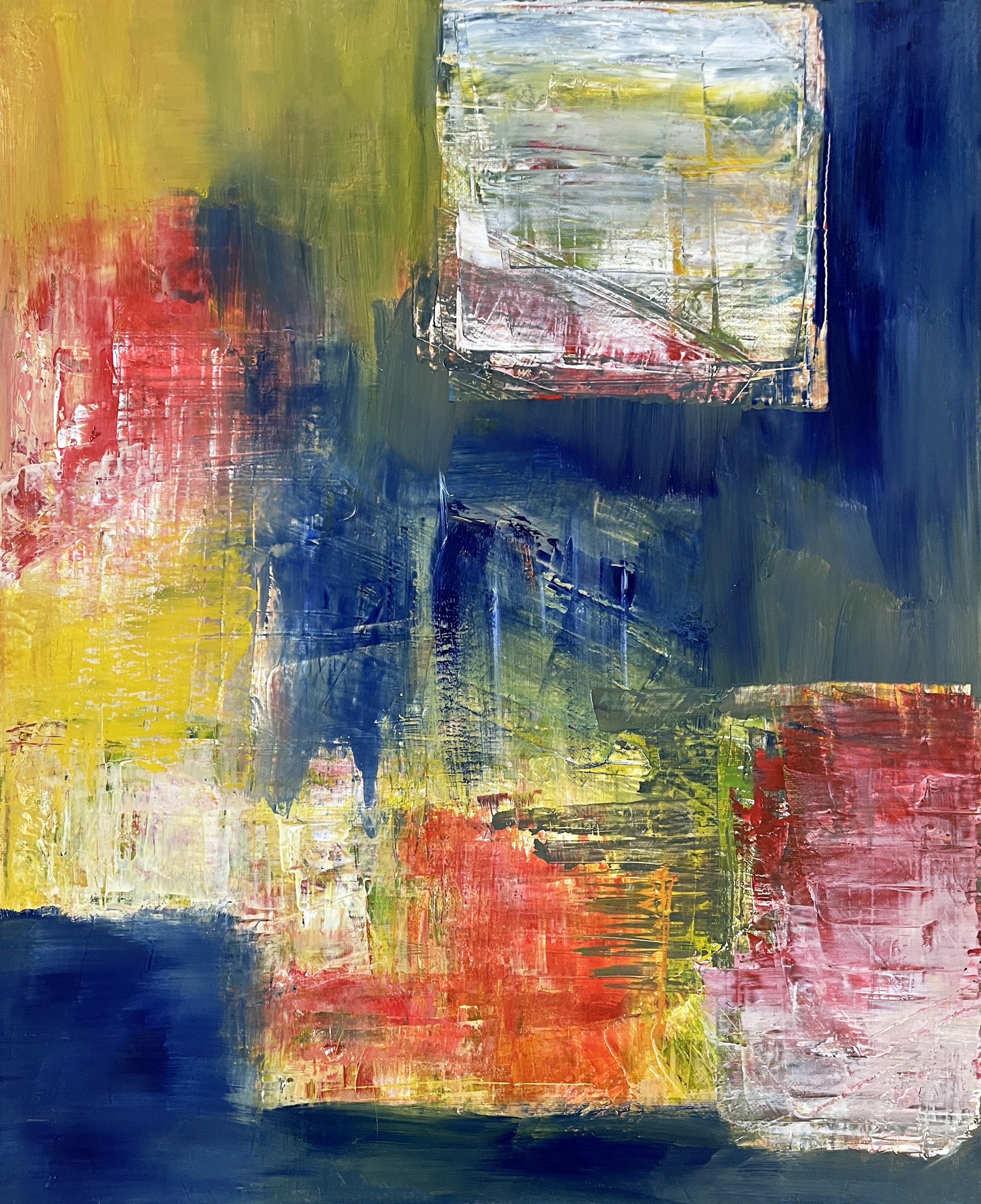
Faithful Through and Through by Robert T. Rogers
And That’s the Way It Happens
You become what you always were. A very big fish.
—from Big Fish, screenplay by John August
The day of my fifth-grade graduation,
I stepped out of my room in the white dress shirt
I borrowed from Uncle Rigo—
Houdini’s straitjacket, arms akimbo ready to leap into water—
Mom laughed.
“That’s because Atacheo kids stop growing arms after ten,” she said.
“Only the neck keeps stretching—so their big heads don’t roll away.”
Uncle Rigo—short or not—was down for anything:
eating scabbed-over beans scraped across a calcified tortilla,
or driving all night down I-5 to Mexico,
where someone needed a miracle only he could perform.
On those long rides, the sky clutched the road—
Bic-black ink,
tie-dyed with gasoline rainbows,
lit by Wite-Out headlights—
and he’d face the dark with sunglasses,
speaking to me like an old friend over piping-hot chili burgers and fries.
I was a remora
feeding off the morsels that dropped from his mouth:
Scripture intermingled with street-smarts,
turning guaro into wine,
and praying for vatos with unclean spirits.
He told me where words came from:
how pomegranate meant “seeded apple” in Old French,
how algae—photosynthetic eukaryote—
rhymed with the Spanish word for “butt cheeks,”
or about exit wounds and exegesis,
and the kick that left a triangular gap in his front teeth.
“You know, man,” he said.
“My Savior, you know why I love him?”
His voice grew soft when he got serious.
“He brought me to Los like a salmon jumping over a dam.
But I’m no wetback, man,
because Jesus Christ put my whole body in living water.”
The Lord’s words were imprinted on his mind
like scritta on the page—black and white—
though he never took their cue
on the grey area of his sister’s break from the shoal:
my mother and her unfathered fry.
We didn’t have to hide from him,
even when I stole a lingerie ad my teacher forgot to remove from the paper.
I craved those grayscale, image-transferred breasts,
hoisted by delicate lace.
He knew it all, yet chose to wade with me in the aphotic.
Once we arrived in TJ, Uncle Rigo preached the Word from the pulpit—
his face chile red with fervor—
and I ministered from within the multitude
of Sánchez Taboada women and children and white missionaries,
a translator between two tongues, two realities:
the have-nots and the have-not-enoughs.
«¿Qué quieren?» “What do they want?”
I was a prepubescent No-Man’s-Land,
an Atlas shouldering two worlds,
burdens that neither language nor pity could voice—
but I did it anyway,
because I knew Rigo, the man, needed my help.
There had always been buoyant wilderness within him—
an alevin dwelling within Jonah,
whose strength rippled through the canals of his being,
consuming the man without,
growing larger and larger, until it alone was left:
a really big fish.
Uncle Rigo’s body floated away in Los Angeles,
while his spirit joined the angels and the ageless,
swimming in waters that knew no depth or shore,
where all life neither ends nor begins—only continues.
In life, my uncle kept me in his gravel beds
of freshwater streams, with anadromous love
that prepared me to swim in the vast ocean of his absence.
January ended on a dark day,
even the pomegranates outside my window
seemed in mourning—dried and black.
It was my turn to get dressed,
to attend Uncle Rigo’s graduation—
the one he’d been working toward
since he came as a parr,
caught by a fisher of men.
As I donned a black dress shirt and tie—
proportions fitting my 37-year-old frame—
I realized that while one may stop growing in size,
one never ceases to grow in stories.
I pondered on God’s cruel alchemy—
to place so strong an essence in so fragile a vessel,
the everlasting in the mortal.
About the author:
Jose Oseguera is an LA-based writer of poetry, short fiction and literary nonfiction. His writing has been featured in Emrys Journal, North Dakota Quarterly and Sonora Review. He is the author of the poetry collections “The Milk of Your Blood” (Kelsay Books, 2021) and “And This House Is Only a Nest” (Homebound Publications, 2024).
In the artist’s words:
Robert T. Rogers (b. Memphis, TN) artistic practice spans painting, digital photography, drawing, and writing. Drawn from intimate reflections and a studied curiosity about belief systems, his work often engages with secular culture while drawing inspiration from devotional art and Judeo-Christian spirituality.
He holds an M.A. in Advertising and a B.A. in American Studies from the University of Texas at Austin, along with a Graduate Certificate in Visual Arts from Harvard Extension School. He studied visual arts at the Museum of Fine Arts, Boston; Harvard University; and the Massachusetts College of Art and Design.
Rogers’ work has been exhibited at The Naturalist Gallery of Contemporary Art, Washington, DC; Photo Artfolio, Boston, MA; and has been published by Vita Poetica Journal. His work is included in private collections and corporate settings, including Mass General Brigham, as well as Hilton and Marriott hotels.
Thanks, Jose.Osguera. Best to the Osguera’s, 🙏👌🌹‼️